





















































































Poker Starting Hands Guide Best Starting Hands CardsChat

Poker Starting Hands - Comprehensive guide to which poker hands you should play, including a Texas Hold’em poker starting hands chart.
 Reviewed by WSOP Winner Chris ‘Fox’ Wallace
- Beginner-friendly
- 15 minute read
Each hand of Texas Hold’em begins with each player asking themselves the same question: should I play these cards, or not?
There are 169 different two-card combinations in a deck of cards, and some of those poker starting hands are obviously better than others – most players will know that a pair of aces is good and a 2-7 is bad.
But choosing which poker hands you should play isn’t as simple as waiting for pocket aces, as there are other factors you’ll need to consider such as your position at the table, the action ahead of you and the playing style of your opponents. Working out the right poker starting hand percentages isn’t always a straightforward equation, then, but understanding what makes a hand playable and when you should save your chips for a better spot is a skill you can certainly pick up.
You certainly don’t want to play every hand the dealer gives you, and even good players will fold a lot of their hands, but how can you know which poker hands to play?
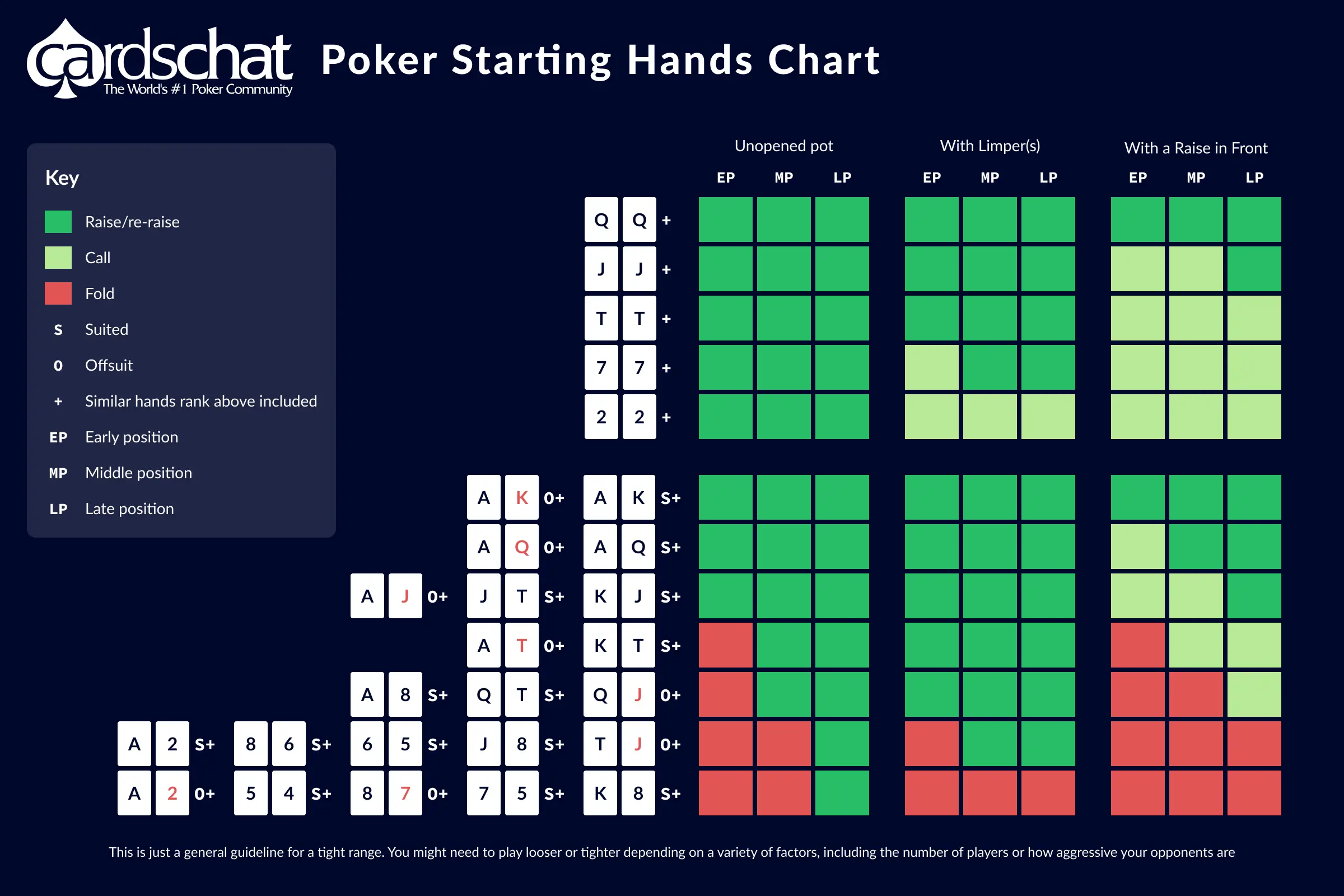
With our handy chart you can see which hands to raise, call and fold with depending on your position at the poker table, with at-a-glance advice on cards to be played from early (EP), middle (MP) or late position (LP).
As you can see, the optimal move can vary depending on if you’re the first player to enter the pot (‘Unopened Pot’), if there’s already been one or more callers (calling the blinds preflop is known as limping, hence ‘With Limper(s)’), or if there’s already been a raise in front of you.
Just a quick look at this poker cheat sheet shows that a greater number of different hands can be played from late position, compared to early position, and that the number of callers or raises in front of you has an effect on how you should play the hand.
Click or tap the link below to save this Texas Hold’em chart for future reference, or bookmark this page to help you when playing online.
 Starting hands chart Download PDF
VIEWStarting hands chart Download PDF
Before we focus on starting hand recommendations, let’s take a quick look at how poker hands are described. As you can see in the chart above, ‘s’, ‘o’ and ‘+’ are used frequently, but what do they mean?
- s
– indicates that the two cards are ‘suited’, i.e. both of the same suit
- o
– reveals the opposite to be true: the cards are ‘offsuit’, i.e. of two different suits
– shows that all similar hands that rank above it are included
Some examples from the chart above:
- The top row shows the hand ‘QQ+’. Similar hands (pairs) that rank above this would be KK and AA, so the ‘+’ in ‘QQ+’ shows that pocket kings and pocket aces are also included in this row.
- Towards the bottom, we see ‘A8s+’. This represents an ace with a suited 8, 9, 10 or J (AQs has its own entry a little higher).
Looking at the starting hands chart above, three things should be clear:
- The stronger your hand (i.e. closer to the top of the chart), the better
- You should generally be more aggressive with limpers in the hand, and a little more cautious vs. raisers
- More hands can be played from late position than anywhere else This third point is one of the most useful concepts for new poker players to understand. Acting after your opponents is called being ‘in position’, while acting before them is known as being ‘out of position’. Why is this fundamental to poker strategy? Because seeing what other players choose to do before you act is a significant advantage – so much so that the dealer position changes with every deal, so no one benefits more than anyone else.
Each position at the table has a name, and the image below displays search of them at a typical full ring table (for 10 players simply add an additional middle position player). Meanings of the abbreviations are as follows:
- SB
Small Blind
- BB
Big Blind
- UTG
Under the Gun
- MP
Middle Position
- HJ
Hijack
- CO
Cut Off
- BTN
Button
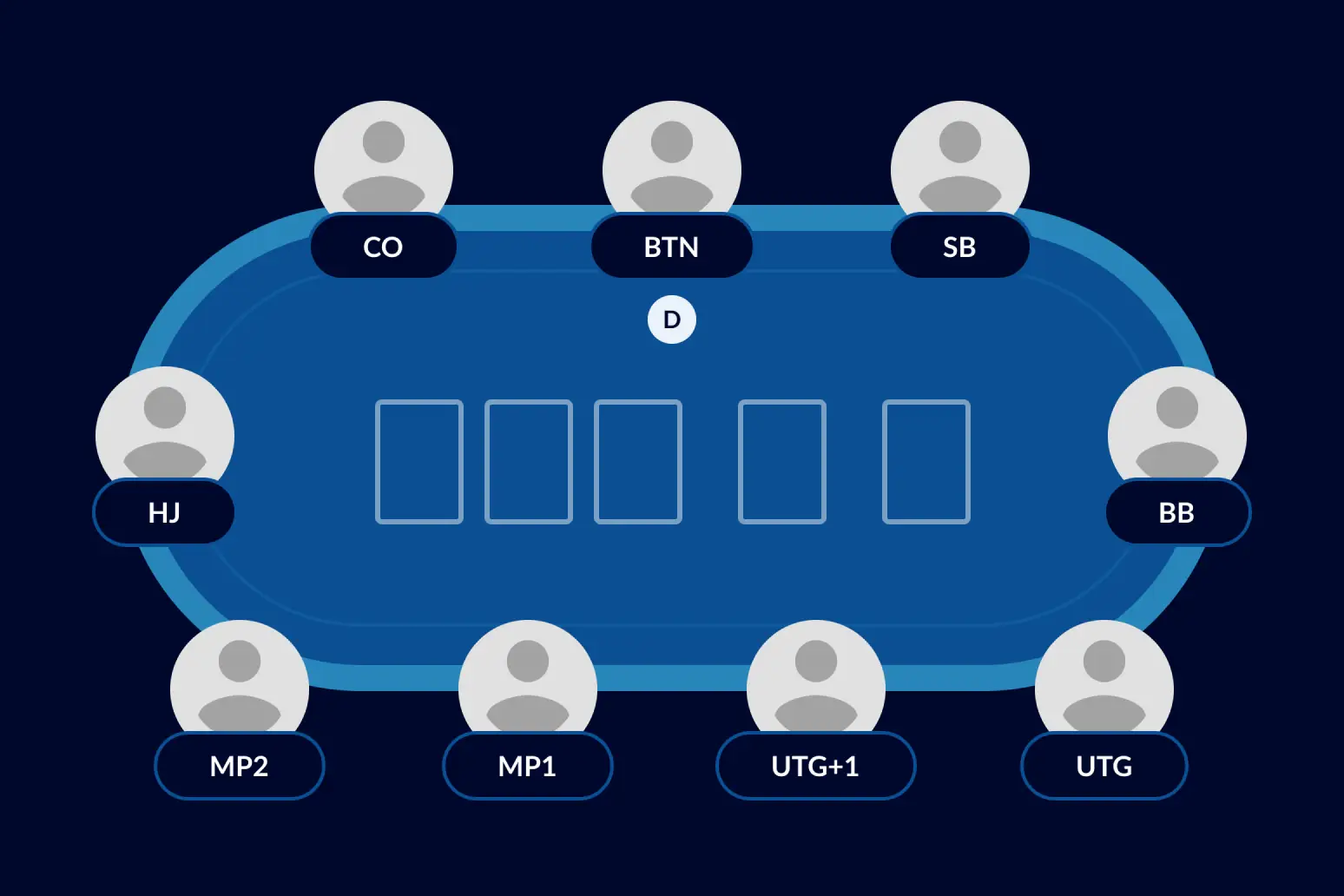 Now that you know what position is, and why it’s important, you can use the chart below as a basic guide on which poker hands to play from which position. Note that more suited hands are classed as playable when compared with offsuit hands.
- Any Position
- Mid or Late Position
- Late Position
- Unplayable hand
Pairs and Suited Hands
| A-A | A-K | K-Q | Q-J | J-T | T-9 | 9-8 | 8-7 | 7-6 | 6-5 | 5-4 | 4-3 | 3-2 |
|---|---|---|---|---|---|---|---|---|---|---|---|---|
| K-K | A-Q | K-J | Q-T | J-9 | T-8 | 9-7 | 8-6 | 7-5 | 6-4 | 5-3 | 4-2 | |
| Q-Q | A-J | K-T | Q-9 | J-8 | T-7 | 9-6 | 8-5 | 7-4 | 6-3 | 5-2 | ||
| J-J | A-T | K-9 | Q-8 | J-7 | T-6 | 9-5 | 8-4 | 7-3 | 6-2 | |||
| T-T | A-9 | K-8 | Q-7 | J-6 | T-5 | 9-4 | 8-3 | 7-2 | ||||
| 9-9 | A-8 | K-7 | Q-6 | J-5 | T-4 | 9-3 | 8-2 | |||||
| 8-8 | A-7 | K-6 | Q-5 | J-4 | T-3 | 9-2 | ||||||
| 7-7 | A-6 | K-5 | Q-4 | J-3 | T-2 | |||||||
| 6-6 | A-5 | K-4 | Q-3 | J-2 | ||||||||
| 5-5 | A-4 | K-3 | Q-2 | |||||||||
| 4-4 | A-3 | K-2 | ||||||||||
| 3-3 | A-2 | |||||||||||
| 2-2 |
Off-Suit Hands
| A-K | K-Q | Q-J | J-T | T-9 | 9-8 | 8-7 | 7-6 | 6-5 | 5-4 | 4-3 | 3-2 |
|---|---|---|---|---|---|---|---|---|---|---|---|
| A-Q | K-J | Q-T | J-9 | T-8 | 9-7 | 8-6 | 7-5 | 6-4 | 5-3 | 4-2 | |
| A-J | K-T | Q-9 | J-8 | T-7 | 9-6 | 8-5 | 7-4 | 6-3 | 5-2 | ||
| A-T | K-9 | Q-8 | J-7 | T-6 | 9-5 | 8-4 | 7-3 | 6-2 | |||
| A-9 | K-8 | Q-7 | J-6 | T-5 | 9-4 | 8-3 | 7-2 | ||||
| A-8 | K-7 | Q-6 | J-5 | T-4 | 9-3 | 8-2 | |||||
| A-7 | K-6 | Q-5 | J-4 | T-3 | 9-2 | ||||||
| A-6 | K-5 | Q-4 | J-3 | T-2 | |||||||
| A-5 | K-4 | Q-3 | J-2 | ||||||||
| A-4 | K-3 | Q-2 | |||||||||
| A-3 | K-2 | ||||||||||
| A-2 |
Many players open up their range of playable hands in late position, deciding that any hand that is not two bad offsuit cards is fair game for raising an unopened pot. Picking up the blinds in this way can be a useful way to build a stack without needing a decent hand; only a few hands have the strength to be viable to continue beyond the preflop action, but with late position raises you don’t necessarily need a strong holding.
The ’correct’ poker starting hand percentage depends on numerous factors, then, but you’ll find that most playable hands tend to fall into one of the following categories: pairs, aces, other premium hands, connectors and gappers.
Let’s explore these different hand types a little further, starting with pocket pairs.
Pocket Pairs
Pairs always look great, but there’s a big difference between ‘premium’ pairs like QQ, KK or AA, medium pairs like 77-TT, and small pairs like 22-66, with some hands much stronger than others.
- Premium pairs should generally be raised preflop, to protect your strong hands from being outdrawn by weaker ones. In most cases you’ll be looking to build a big pot before the flop, or even going all-in, as it’s important to press your advantage when you have one. Simply calling a preflop bet to set a trap is an option, but isn’t advisable with anything but pocket aces (KK and QQ, if slowplayed to set a trap, are easily undone by a single ace on the flop).
- Medium pairs play similarly to small pairs, in that much of their value comes from those moments where you flop a set (a concealed three-of-a-kind). These pairs are also capable of winning a pot without improving, however, making them worth a mid- to late-position raise in an unopened pot.
- Small pairs can win big pots, but they usually require some help in the form of a third card to make a set. Raising an unopened pot from late position with a small pair is a move similar to a bluff, in that you’re not hoping for a caller. However, if you do get called, you have the slim chance to improve to a set – a very strong hand. Preflop limpers can make calling with a small pair a much more attractive play, as the extra chips in the pot give you better pot odds to hit that third card and make a set. This is known as ‘set-mining’. Facing multiple preflop raises, however, makes this play too expensive to be worthwhile, so fold if you encounter significant aggression.
Other Premium Hands
This category includes hands like JJ, AKs, AQs and AKo, which are certainly attractive but not quite as strong as premium pairs.
Raising from late position is wise, as you will often have the best hand preflop with the potential to hit an even stronger hand on the flop, and depending on your table you may consider raising or re-raising from other positions too.
However, these hands can be easily undone by the ‘wrong’ flop, so don’t grow too attached to them. JJ is strong preflop but once an overcard falls it’s not a hand in which you can have a lot of confidence. Similarly, AKs, AQs or AKo is often the strongest hand preflop, but if it doesn’t connect with the flop you’re left with only a high card and can be beaten by the smallest pair.
These attractive hands can be difficult to let go of, but if you don’t connect with the flop and face serious aggression, you need to get real about your chances.
Aces
Here we’re talking about non-paired and non-premium aces, such as A2-AJs or any offsuit ace other than AKo.
Without a strong kicker, one of the main dangers facing a non-premium ace hand is, ironically, flopping an ace. This is because any other aces out there will likely have a higher kicker, resulting in your hand being dominated and ending up a loser.
Suited aces have more appeal, given the possibility of making the nut flush, but you should consider these as drawing hands and aim to see the flop cheaply, without committing too many chips.
Suited Connectors
These are cards closely connected by rank, such as 34, 78 or 9T, which are of the same suit. The strength of these hands lies in the potential they have when it comes to making a straight or flush, but the most common situation, aside from flopping absolutely nothing, will be flopping some sort of small piece like a pair or a gutshot draw. It’s rare that you’ll flop a big hand with suited connectors, and you may end up with a weak flush or straight that will be hard to fold.
On the flipside when you do make your hand with suited connectors, you will often have a well disguised hand that could win you a lot of chips.
Because of the above considerations, suited connectors are best played when it’s cheap to do so. Preflop raises and 3-bets are hard to call with drawing hands like these, unless the effective stacks are deep and you believe you have an edge on your opponent.
Suited connectors also play much better in position than out of position, so while it makes sense to open-raise them from late position, a raise from early position isn’t recommended. And while we generally don’t encourage too much preflop calling (if the action is folded to you and you have a hand you want to play, you should generally come out raising – if you don’t think your hand is good enough to raise with, just fold), suited connectors may actually be a hand worth limping with.
Offsuit connectors play similarly, but worse. A call or raise from late position may be appropriate if the cards are fairly high (e.g. 89o+), the pot is small and opposition is weak, but proceed with caution.
Suited Gappers
Gappers almost connect in the way that connectors do, but have a gap between the cards. Hands like 79s and TQs are referred to as ‘one-gappers’, given that the cards have a gap of one rank between them, and can make for good, disguised hands when they hit. The bigger the gap (e.g. 96s would be called a ‘two-gapper’), the more the hand is disguised, but remember that you’re not going to connect with the flop in a meaningful way too often.
Nevertheless, when gappers do hit the flop they can make some unexpected and unpredictable hands, so it’s worth considering playing them if conditions are right. As with connectors, you are looking for a situation where the cards aren’t too low, the price isn’t too high, and ideally you have position. And just like connectors, having them suited is a big plus.
What to hold, what to fold, and when to raise are all key things to learn as you improve as a Hold’em player. But every table is different, and the hands you decide to play should always take the general table dynamic into consideration.
A table might be fairly passive, with lots of preflop limpers and multiway pots. Or, conversely, it might be filled with loose-aggressive players whose frequent raises and 3-bets discourage limpers and lead to big pots, contested by fewer players.
When you first sit at a new poker table, whether live or online, it’s always worth taking some time to read the temperature of the table in this way. Once you understand the overall feel of the game – the table dynamic – you can adjust your own play to exploit the situation.
To this end, we generally recommend playing a little tighter than average at a very loose table, and a little looser than average at a very tight table.
The former puts you in a position to maximize value with good hands, so you should focus on the top end of your range and not invest too much in pots with hands like gappers or low connectors. The latter helps you pick up a lot of small pots and blinds, as you are unlikely to face as much resistance at a tight table, so you can add more suited connectors, gappers and bluffs to your range.
What are good starting hands in Texas Hold’em (what hands should I play in poker preflop)?
The best hands to play in poker preflop will always be big pocket pairs (such as Ace-Ace, King-King and Queen-Queen), followed by big suited connectors such as Ace-King, as well as medium pairs. Your position heavily dictates how strong your hand is, which is why tables such as the one above divide many hands into whether they’re playable from early, middle or late position.
Who is the first to bet in Texas Hold’em?
The player directly to the left of the big blind is the first to place a bet before the flop, with betting continuing in a clockwise direction. After the flop, the action starts with the first player still in to the left of the button.
How many different starting hands are there in poker?
There is a total of 169 non-equivalent starting poker hands in Texas Hold’em, comprising 13 pocket pairs, 78 suited hands and 78 unsuited hands. Any one of these hands can win, however we recommend that beginning poker players play a tighter style – if you play the right hands you’ll win more pots.
What does ‘preflop’ mean?
Preflop refers to the phase after big blind and small blind have been posted but before the flop has been revealed. Players have their pocket cards and place bets during this initial phase (also referred to as the preflop betting phase).
How much should I raise?
This depends heavily on your position and the stack sizes at your table. From early position you tend to need a stronger hand to raise with, so a minimum raise may be enough to be taken seriously by your opponents, while raising from the button is a common move (to ‘steal the blinds’) so a larger bet may be in order. Middle position is trickier, but as a baseline we’d recommend raising three times the big blind with hands like 22+/AT+/KJ+/89s-JQs/A2s-A5s – around 15.5% of hands. If we have tight players on our left we can start to raise with hands like 56s-78s and QJ/A9s/K9s/KTs/QTs/J9s, opening up our range even more.
What hands should I play in poker preflop?
The hands that should be played preflop can be determined by looking at three main concepts: equity, implied odds and position. Equity refers to how much your hand is worth in comparison to other players’ hands; implied odds refers to the potential winnings for that hand versus the amount you need to call; position refers to where you are in relation to the button.
In general, the best hands to play preflop will be big pocket pairs (Ace-Ace being the best), other premium hands and big suited connectors.
What percentage of poker starting hands should I play in Texas Hold’em?
Whether or not to play a hand depends on various factors, but as a general rule playing more than 15-20% of hands at a full-ring table (9-10 players), over a significant time period, would usually be considered too loose. At a six-handed table it’s important to relax your requirements a little, and opening around 20% of pots would not be considered unusual.
What poker hands should I fold?
Read through the page above to see which Texas Hold’em hands you are recommended to play, and from which position – all other poker hands can generally be folded. Many new players expect to play a lot of hands in their first poker games, but for the reasons explained above it’s not recommended. The majority of hands you will receive in any poker game will not be strong enough to play and so folding in poker is a very common action for players of all experience levels.
The best hands to play in poker preflop will always be big pocket pairs (such as Ace-Ace, King-King and Queen-Queen), followed by big suited connectors such as Ace-King, as well as medium pairs. Your position heavily dictates how strong your hand is, which is why tables such as the one above divide many hands into whether they’re playable from early, middle or late position.
The player directly to the left of the big blind is the first to place a bet before the flop, with betting continuing in a clockwise direction. After the flop, the action starts with the first player still in to the left of the button.
There is a total of 169 non-equivalent starting poker hands in Texas Hold’em, comprising 13 pocket pairs, 78 suited hands and 78 unsuited hands. Any one of these hands can win, however we recommend that beginning poker players play a tighter style – if you play the right hands you’ll win more pots.
Preflop refers to the phase after big blind and small blind have been posted but before the flop has been revealed. Players have their pocket cards and place bets during this initial phase (also referred to as the preflop betting phase).
This depends heavily on your position and the stack sizes at your table. From early position you tend to need a stronger hand to raise with, so a minimum raise may be enough to be taken seriously by your opponents, while raising from the button is a common move (to ‘steal the blinds’) so a larger bet may be in order. Middle position is trickier, but as a baseline we’d recommend raising three times the big blind with hands like 22+/AT+/KJ+/89s-JQs/A2s-A5s – around 15.5% of hands. If we have tight players on our left we can start to raise with hands like 56s-78s and QJ/A9s/K9s/KTs/QTs/J9s, opening up our range even more.
The hands that should be played preflop can be determined by looking at three main concepts: equity, implied odds and position. Equity refers to how much your hand is worth in comparison to other players’ hands; implied odds refers to the potential winnings for that hand versus the amount you need to call; position refers to where you are in relation to the button.
In general, the best hands to play preflop will be big pocket pairs (Ace-Ace being the best), other premium hands and big suited connectors.
Whether or not to play a hand depends on various factors, but as a general rule playing more than 15-20% of hands at a full-ring table (9-10 players), over a significant time period, would usually be considered too loose. At a six-handed table it’s important to relax your requirements a little, and opening around 20% of pots would not be considered unusual.
Read through the page above to see which Texas Hold’em hands you are recommended to play, and from which position – all other poker hands can generally be folded. Many new players expect to play a lot of hands in their first poker games, but for the reasons explained above it’s not recommended. The majority of hands you will receive in any poker game will not be strong enough to play and so folding in poker is a very common action for players of all experience levels.
Deciding how and when to play each of the possible poker hands preflop is an art, but using these guidelines will give you everything you need to perfect it. The reality is that many decisions will be opponent- and situation-dependent, and experience will certainly help when it comes to recognizing opportunities and avoiding mistakes. Remember that even the best players lose more hands than they win, and try to make the best decisions whenever you have the chance. Ready to start playing online? You can check out real money poker sites here.
Enjoyed this content? Share it with your friends!
- Share on TwitterShare on Twitter
- Share on FacebookShare on Facebook
- Share on LinkedInShare on LinkedIn
Looking to level up your Poker Skills further?
View More Guides
- Calculate Equity in Poker
- Set Mining
- Spin And Go
- Tilt
- Tips For Winning Online Poker
FAQ
二十一點還是撲克?誰比較好贏錢!
在賭場裡,大家最常玩的兩款紙牌遊戲非二十一點(Blackjack)與撲克(Poker)莫屬。很多人都好奇:到底哪一個比較容易贏?其實,這取決
撲克牌型排行榜:10招稱霸牌桌必殺技!
嘿,撲克牌的牌型階層就像遊戲的秘密武器,記住了它,你就能在牌桌上自信滿滿!從最強到最弱一共有10種,我們來一一認識,讓你輕鬆上手。 皇家同花
撲克牌超刺激!新手5分鐘上手贏大獎
嘿,撲克牌超有趣的遊戲!它是一種用52張牌玩的紙牌遊戲,玩家比手牌大小,還要下注搶獎池,結合運氣和聰明策略。 撲克起源於19世紀美國的河船上
Bagaimana cara belajar poker online?
Yes. The GGPoker app is available for download on both the App Store (iOS) and Google Play Store (Android) in most supported regions. In some cases, Android users may need to install the APK directly from the GGPoker site.8 Agu 2025
撲克最強牌型大公開!皇家同花順無敵秘訣
嘿,撲克迷!在撲克牌遊戲裡,最強的牌型就是皇家同花順啦!想像一下:10、J、Q、K、A五張牌,全是同一花色,比如黑桃。這組合超稀有,機率只有
find good poker game on motorwork1993.com
本網站僅收集相關文章。如需查看原文,請複製並打開以下連結:Poker Starting Hands Guide Best Starting Hands CardsChat